
Advanced Vitrification in Bangalore: Precision Rapid Freezing
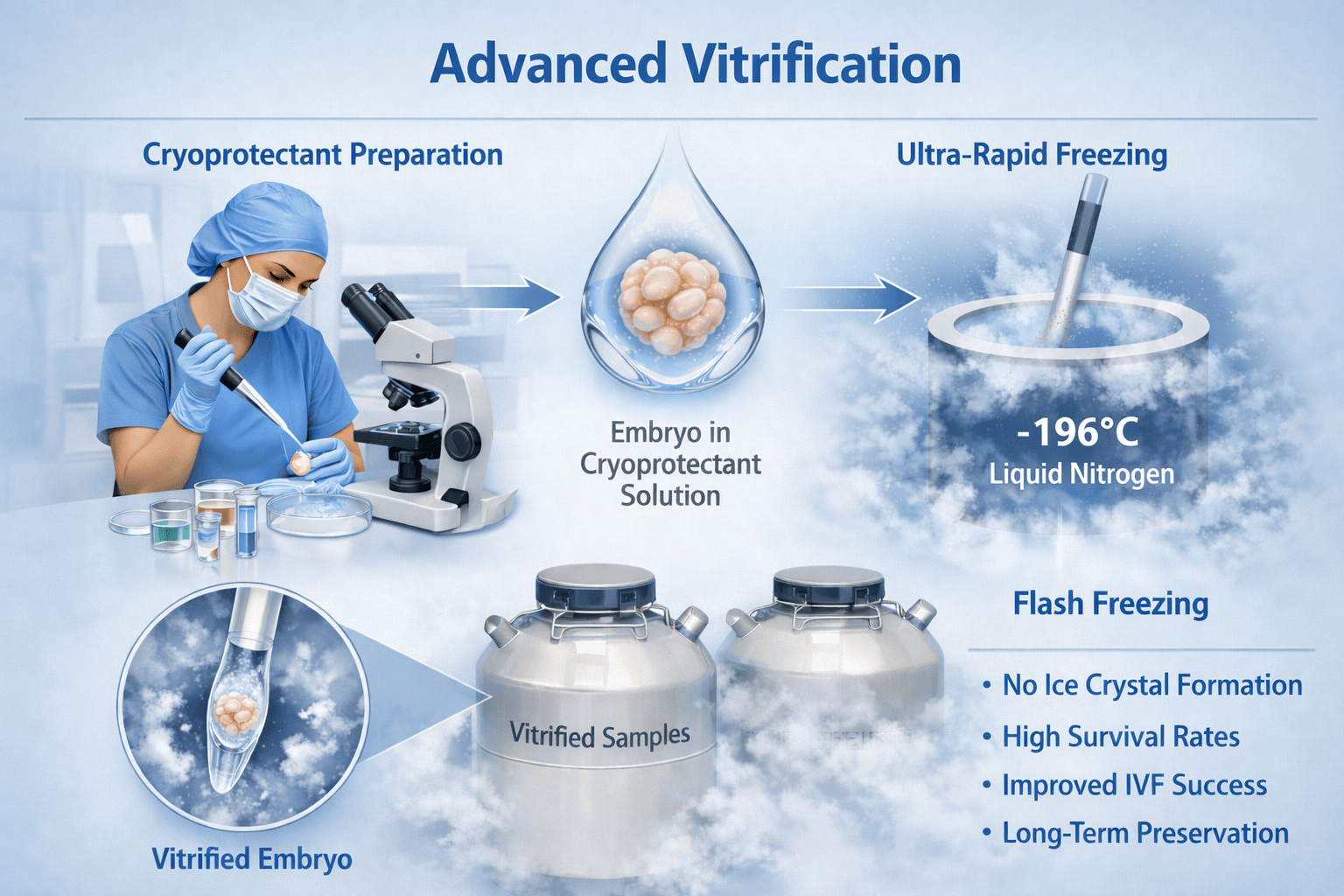
Advanced Vitrification is the "gold standard" of cryopreservation. Unlike older, slow-freezing methods that could lead to ice crystal formation and cell damage, vitrification uses ultra-rapid cooling to transform the embryo into a glass-like state. This technology preserves the biological integrity of eggs and embryos with unmatched precision, ensuring they remain in peak condition for future transfer.
About This Treatment
What you need to know
The Science: Glass vs. Ice
The primary enemy of a frozen cell is the “ice crystal.” When water freezes slowly, it expands and creates jagged crystals that can pierce the delicate cell membrane. By utilizing Advanced Vitrification in Bangalore at Aikya, we use high concentrations of cryoprotectants and liquid nitrogen at -196°C. The cooling happens so fast—thousands of degrees per minute—that the liquid solidifies into a smooth, “vitrified” (glassy) state without a single crystal forming.
The Aikya Vitrification Protocol: Step-by-Step
- Dehydration: The embryo is placed in a specialized solution to safely remove excess water from the cells.
- Cryoprotectant Loading: We introduce protective fluids that safeguard the cellular structure during the cooling process.
- The Flash Freeze: The embryo is placed on a specialized carrier and plunged into liquid nitrogen, reaching a stable state instantly.
- Secure Storage: Embryos are stored in high-security, vacuum-insulated tanks monitored 24/7 by our embryology team.
Why Choose Aikya for Vitrification in Bangalore?
- Closed System Technology: We use advanced “closed” vitrification systems to prevent cross-contamination, ensuring the highest safety standards.
- Expert Embryologists: Rapid freezing is a high-skill technique; our team is trained in the precise “loading” maneuvers required for survival.
- State-of-the-Art Lab: Our facility features independent power backups and real-time tank monitoring to protect your precious biological assets.
- Integrated Care: Perfectly synced with our Laser-Assisted Hatching and Blastocyst Culture programs.
Treatment Process
Step-by-step journey to better health
Dehydration
The embryo is placed in a solution to safely remove excess water.
Cryoprotectant Loading
We introduce specialized fluids that protect the cellular structure during cooling.
The Flash Freeze
The embryo is placed on a specialized carrier and plunged into liquid nitrogen.
Secure Storage
Embryos are stored in high-security, alarmed tanks monitored 24/7 by our embryology team.
Key Benefits
Why patients choose this treatment
Who Should Consider This?
Is this treatment right for you?
- Couples opting for a “Freeze-All” cycle to allow the body to recover before transfer.
- Patients undergoing PGT-A/PGT-M genetic testing who need a waiting window.
- Individuals choosing to delay parenthood (Social Freezing) or preserving fertility before medical treatments.
- Couples with excess high-quality embryos from a single IVF cycle for future siblings.
Important Considerations
What to discuss with your doctor
Please consult our specialists to understand how these considerations apply to your individual case.
- Technical Skill: Vitrification is extremely safe but highly operator-dependent. At Aikya, only senior embryologists perform this delicate “flash-freeze.”
- Natural Selection: While most embryos survive the thaw, a very small percentage (less than 10%) may not resume growth if they were of borderline quality before freezing.
- Equipment Reliability: Storage requires constant liquid nitrogen levels. Our lab uses automated alarm systems to ensure zero fluctuations in temperature.
Frequently Asked Questions
Answers to common questions
No. With vitrification, the risk is minimal. Studies show that babies born from frozen-thawed embryos have the same healthy development as those from fresh transfers.
Theoretically, indefinitely. There have been successful births from embryos frozen for over 20 years. The biological process is completely suspended at -196°C.
In many cases, yes. A “Freeze-All” strategy allows your hormones to return to baseline after stimulation, which often creates a more welcoming environment for the embryo to implant.